Philadining Home

Showing posts with label Chinese. Show all posts

Thursday, April 14, 2011

925 Race Street - Pearl Restaurant - Szechuan Noodles

UPDATE: CLOSED
As mentioned in this review, there's lots of turnover in this location, and sadly, Pearl didn't last long either... it's been replaced by a budget buffet... Oh well.. 

I could almost devote a blog to the comings and goings in this one storefront: it's been the home of a large number of exciting places. Sadly, none of them has stuck around for long.  I first was intrigued by it being the home of a dumpling place, one of those spots where you could get a plate-full for a buck, along with a stuffed scallion pancake, and other cheap and quick snacks.  That didn't last long...

Following that was one I was really pulling for: Zhi Wei Guan, who also called themselves the Magical Kingdom of Dough.   They served the food of Hangzhou, focusing at least initially on dumplings and other noodle dishes. They had some very tasty soup dumplings, and indeed some of the wontons and noodles were quite good, but I found their other dishes to be even better.  But... they didn't last too long either.  I miss them.

There probably was something in there in the interim, but it seems like only a few weeks ago, we were excited to try Tang's Kitchen, which seemed to feature a variety of traditions, but we especially liked their homey Taiwanese and Shanghainese dishes, like Three Cup Chicken and Lions Head meatballs. They made a passable version of soup dumplings as well, and even better: the fried juicy buns that looked like potstickers, but contained soupy, juicy interiors along with the pork filling (pictured at left.)  But... Tang's didn't last long... I swear it was only a few weeks,

We were saddened to see their awning go down, but when the new one went up, we had reason for at least cautious optimism: It said Pearl Restaurant - Szechuan Noodles.  No, it's not a new location for that fusion-y Vasian place on Chestnut st near Rittenhouse square that closed a while back, this is a whole different vibe, not a slickly designed scene with a club upstairs. 


But you don't need a doorman or a velvet rope to get my attention, the phrase Szechaun Noodles will do it!

It's not a big menu, and despite the subtitle of Szechuan Noodles, it's not exactly noodle-centric. The first part of the menu is indeed devoted to soups and other noodle dishes, but there are only 5 or 6 of them. The rest of the menu is made up of fairly sparse descriptions of ingredients, so it's never entirely clear what's going to arrive. There are hoagies, congees, and rice platters, a few vegetables, and a list of meats that just read, Quarter Chicken, or Pork Tongue, or Corned Beef.  Yep. Corned beef. 

More about that in a minute, but first, let's start with noodles! The first item on the menu is the Hot and Sour Crystal Noodle Soup, to which you can add pork, chicken or beef.  The noodles are clear, slippery, and fettuccini-sized, swimming in a slightly spicy broth, studded with ground pork and peanuts. A few slices of tender pork lay on top, marinade and grill-char cutting through the flavorful soup. This was quite good, and made us eager to try the rest) or just come back for this one again and again!)  
We ordered the Pig Tongue, but were told that they had run out. We might be too suspicious for our own good, but we wondered whether the chef just vetoed our order... I hope not, the pig tongue was a favorite dish at these tables back when it was Zhi Wei Guan, so I'd like to see what this version is like.  The waitress suggested the Quarter Chicken as a replacement.  We were surprised to discover that it was served cold, but not disappointed. It was delicately steamed, beautifully tender, and marinated in a light wine-based sauce.

A variety of cold vegetables were lightly pickled, a bright, refreshing accompaniment to the heavier foods. 

The most surprising item on the menu was Corned Beef.  It was indeed brined, and even had the salty, cured flavor of the item you might eat on St Patrick's day. In this case, it was simply sliced  and served warm, over some pickled radish and carrot. 

The flavor was mild, not especially exciting, but the combination of the lightly salty beef and the sour vegetables was pleasant enough.

We're eager to try more of the noodles, but also the sandwiches and rice platters.  Prices are more than reasonable, actually downright cheap - soups are $5-6, the meats at $6.95 are the most expensive items. There's lots for under $5.

It's an odd niche that this place has staked-out, but here's hoping that they can make a go of it in this location, where others have failed.  Philly can use as many Szechuan Noodles as it can get! 

Pearl Restaurant
925 Race St
Philadelphia, PA 
215-922-1018


Regional Cuisine in Chinatown: Fuzhou

On the surface, the majority of restaurants in Philly's Chinatown appear to be variations on a theme: Americanized food, based loosely on Cantonese or Hong Kong style cooking. Of course, there are exceptions, like the Sichuan cuisine offered at Four Rivers, Szechuan Tasty House and E Mei, or the Shanghainese specialties at Dim Sum Garden and Sakura Mandarin.  There's Taiwanese food at Empress Garden, if you pick carefully, or can navigate the Chinese-only listings on the back page of the menu.  Various regional cuisines can be found on the menus of Rising Tide and Red Kings. And of course there are a few obvious non-Chinese places as well.

But among the many places that present themselves as the standard Chinese restaurant, there have long been rumors about the "other menu." It's often true:  many places that outwardly seem like clichéd  Americanized restaurants do offer more authentic food, sometimes on a menu written entirely in Chinese characters.  It's not generally a conspiracy to hide the good food from English-speakers, many of these restaurants simply believe that non-Chinese wouldn't be interested in eating the more traditional food.  When asking about it, it's not uncommon to hear "you wouldn't like that,"  and that opinion might be based on actual experience with unadventurous diners, as much as on vague generalizations about Americans' preferences. It's not without foundation that there are assumptions that Americans don't like meat with bones, or too much fat, or anything with unusual textures.

But sometimes the waitstaff can be quite happy to help you navigate the "other menu." Or even if they're not thrilled about the idea, they can sometimes be convinced to let you order the more Chinese-targeted dishes, and there are often large rewards to going off the familiar path.  But please, for the sake of all of us exploring these more traditional foods, if you're going to do this, play fair. If you order something that you've never had, it's not cool to send it back or refuse to pay for it.  You're exploring, you might get something you don't like.  Suck it up. Try it, even if it looks and smells nothing like you were expecting. If you really don't like it, chalk it up to experience. But you're going to make it harder for the rest of us if you try to send it back, or make a fuss about not liking it.

There are separate, traditional menus at many restaurants in Chinatown, but the majority of the places are still Cantonese. There's plenty of rewarding food to be found there, but we've been most interested lately to explore the cooking of some lesser-known regions. Lurking beneath the surface of some very generic-looking restaurants is the distinctive cooking of Fuzhou.

Perhaps the best example of hiding in plain sight is Chinatown Restaurant. Located at the corner of Tenth and Arch, right in the shadow of the Chinatown arch itself, it would be easy to dismiss this as the typical beef-and-broccoli, sweet-and-sour-chicken joint, serving up all of the usual-suspect dishes for low prices. A while back, we'd heard a rumor that they served the elusive Soup Dumplings (AKA  Shanghai Juicy Buns, or Xiao Long Bao) but when we asked about them they said no, and pointed us to their garden-variety dumplings on the Americanized menu.  But we recently noticed a poster on the wall with pictures of the juicy buns, so we decided to give it another shot.

We were once again provided with a small menu of Chinatown classics, but this time we asked more directly whether there was another menu. Our waitress said that yes there was another menu, that had different food, but did not offer to give it to us. When we directly asked to look at that one, she somewhat reluctantly agreed, and a whole other dimension opened up. The menu is in both Chinese and English, and despite a few perplexing translations,  it's mostly easily decipherable. And after expressing a real interest in those dishes, and asking for advice, the waitstaff was quite helpful, and enthusiastic about recommending things we might want to try.

I'm not sure whether Steamed Shanghai Juicy Buns are traditionally served in Fuzhou, but they make a very tasty version here. The wrappers are a bit thicker and less delicate than those at most of the traditional Shanghainese places, and the buns themselves are a bit smaller too, but this is not necessarily a bad thing: these seem to stay intact a bit better than some, we had no holes or leaks that resulted in soup-loss.  And good thing too, because the broth is delicious, as is the tiny meatball it surrounds. Overall, a very fine example of a juicy bun.

Turning that paradigm inside-out, we tried a Meatball soup, which featured a mild, but satisfying, broth,  which also included several small meatballs, each wrapped in what seemed like a very fine wonton wrapper.

On another visit, our server suggested the Jellyfish soup, explaining that jellyfish wasn't really the right term, that it was some other kind of fish. And indeed, this soup contained a nice light white fish of some sort, with a slightly unusual texture, but not that of what we think of as jellyfish. The broth was slightly sour, from pickled vegetables that also provided some crunch.  We were told that a little red vinegar would be good in it, and indeed, that added acid perked up the flavors nicely.


We did get some actual jellyfish, but prepared in a way we'd never experienced before. Not only were these cross-sections of the bodies, or heads, rather than the tentacles we're used to eating cold, but these pieces were stir-fried, and served hot.  They had the springy-crunchy texture we'd expected from this ingredient, but the shape, the tangy sauce, the temperature, and the inclusion of the surprising element of crunchy fried dough,  all made this a distinctive and very enjoyable dish.

Also from the sea, the Clams in Foo Chow Sauce were another favorite (pictured at top of post.) The tiny clams were perfectly tender, and the red wine-based sauce was unique and tasty.  As similar sauce was served on pieces of bone-in duck. This was almost as tasty, but it was one skinny duck, there just wasn't a ton of meat amongst the bones.

An Oyster Pancake reminded us of a Korean Haemul Pajeun, but with a nice funky, smoky overtone from what were either tiny oysters, or chopped-up pieces, along with scallion in a batter that was crisp in parts, tender and pliable in others.

One of the signature dishes of Fuzhou is Lychee Pork, and it's famous for good reason. It's kind of a really good sweet-and-sour, with a nice balance of fruity and tangy flavors, and no goopy sauce, more of a glaze over the crispy pork nuggets. This would be a crowd-pleasing dish, but was still interesting enough to please our jaded palates.


On the earthier side, we tried a Mutton Casserole, which had tender chunks of what was probably lamb, it didn't display the funkiness of a really old sheep, but it did have nice flavor, as did the broth, which had also soaked into some curls of tofu skin. Black mushrooms threatened to steal the spotlight though, almost tasting meatier than the mutton, making this a very hearty, rib-sticking dish, and a nice counterpoint to the sweeter pork.


We also had some stir-fried rice cakes with pork, and these were a very good version, with tender slabs of noodle interspersed with shredded pork and some greens. We also had some basic stir-fried pea shoots and similarly-prepared water spinach, which were both fine, if not distinctive.

There's plenty more to explore on the menu, and although it might be a small hurdle to convince the servers that you actually want to order the food from Fouzhou, once you do, they can be enthusiastic guides.


 --

We faced a similar skepticism at Happy Restaurant, at 906 Arch St.  We were initially presented with a small and boring menu of Chinatown standards.  We asked for the other, larger menu, and our waitress somewhat grudgingly gave them to us, and was very skeptical about a few things that we ordered. But we eventualy convinced her that we did indeed want some of the food from Fuzhou, and we were well-rewarded. 

It was a little bit of a hard-sell to convince our server that we wanted the Pork Bone with Seaweed Soup. She scowled, and told us that there's really no meat on it, but we insisted, and were glad we did. It indeed might be off-putting to some people: there are large bones, with little or no meat on them, along with wide pieces of seaweed, tied in knots.  The broth is very thin, salty, and tastes mostly of the sea. We liked it quite a lot, but it's not a familiar-tasting soup, it was austere and exotic, odd and intriguing.

We tried their Beer Duck, which was similar to the Duck in FooChow sauce we had up the street, but we liked this one even better. The duck itself was a bit more substantial, and the sauce was a little looser, delicious soaked-up with rice.


Small chunks of spare ribs and cubes of taro soaked up a vaguely sweet sauce.  We liked them, even if they weren't especially distinctive.   Their version of stir-fried rice cakes was fine, if a little bland, as the dish can easily be. The only greens we could seem to get was another rendition of the snow pea shoots, this time with a some chicken broth and garlic. They were quite tasty, and I can never get tired of them, yet we try to find other greens when we can, just for the sake of variety.

 Happy's menu is even bigger than Chinatown Restaurant's, with many unfamiliar (to us, at least) offerings that bear further exploration.

There's nothing wring with Cantonese food, and the flavors of Sichuan are finally well-represented in Philly, thanks to Han Dynasty, E Mei, Four Rivers and Szechuan Tasty House.  But there are many more regional cuisines in China, and if you'd like to try the food of Fuzhou, you can find it at Chinatown Restaurant and Happy Restaurant.  Just ask for the "other menu." 


Chinatown Restaurant
935 Arch St (at 10th)
215-925-8688
downloadable menu at: http://chinatownmenu.com/ChinatownRestaurant.html


Happy Restaurant
906 Arch St.
215-922-5588
downloadable menu at: http://chinatownmenu.com/HappyRestaurant.html

Wednesday, September 29, 2010

Red Kings - Diverse regional Chinese

OK, I'll admit it, it was the soup dumplings that drew us in.

Although we still have Dim Sum Garden and Sakura Mandarin providing Xiao Long Bao here in Philly, there can never be too many sources for these delicate dumplings filled with broth.

Restaurants rarely call them soup dumplings, more often they're listed on menus as steamed juicy buns or just Xiao Long Bao. Here, they're called Steamed Shanghai Juicy Dumplings. And they're good - our batch was delicate, tasty, and none stuck to the steamer or fell apart as we tried to eat them. I don't know for sure that these are made in-house, but, no matter, they're prepared carefully, and served with the requisite ginger-soy sauce.
There are a few other Shanghainese specialties on the menu, but the most interesting thing about Red Kings is that there are offerings from many regions and traditions of Chinese cooking: Shanghai, Sichuan, Fuzhou  -  there are even Thai items.  This normally worries me - a kitchen that tries to do too many things usually fails at all of them.  But from an initial sampling (admittedly, we didn't try the Thai) this place seems to be able to produce credible versions of several styles.  

That's not so unique in Philly's Chinatown: both Four Rivers and Sakura Mandarin feature  Shanghainese and Sichuan dishes and more, and do them pretty well, and now Red Kings joins that club.

If I'm seriously craving full-on Sichuan, I'll still head to Han Dynasty, but if I'm in the mood to try a variety of styles at one meal, this place will be a strong contender. 

We're always in the mood for some spicy dishes from Sichuan, so we tried their Wontons with Chili Soy. These were fairly small, and didn't include much filling, but the noodles were nicely tender, and the sauce had a subtle, but very pleasing, chili kick. They were good, I'd get them again, but if one is specifically craving this dish, the other Sichuan places in town all have solid versions.  Han Dynasty is my favorite (yes I know I need to try Yu Kee...) , but they're actually very  enjoyable at Four Rivers and Szechuan tasty House too. 

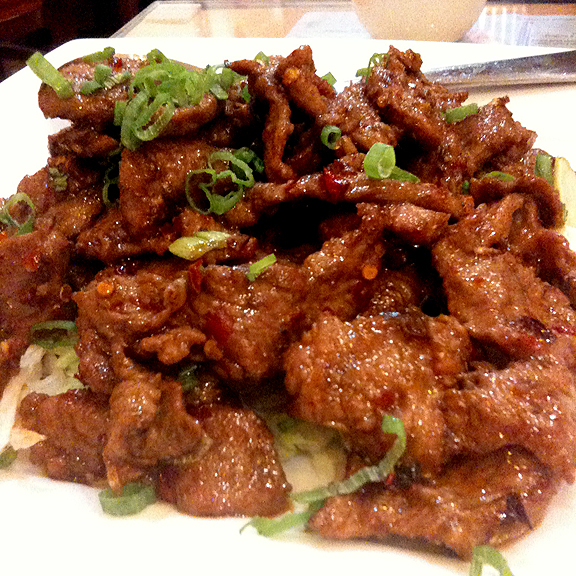
Staying in that Sichuan zone, we sampled the Lamb with Cumin. This is not as hot, or as fully-encrusted with spices as most versions I've had,  but that subtlety allowed the lamb flavor to shine through in a more pronounced way. The meat was very tender and juicy, all in all a more subtle and elegant version than we're used to, but a nice variation.
 
Heading back to the Shanghai influence, we also ordered the Rice Cakes with Pork and Pickled. We're not sure whether that last word was supposed to be pickles, or if they left-off the word  vegetables from the name, but in fact it was a stir-fry of the chewy, noodle-like rice cakes, with plenty of shredded pork and a bit of sour vegetable.  I could have gone for a little more of the sour, crunchy note, but I often think that with rice cake dishes. 

While surveying Shanghai eating, one really ought to try the Dong Po Rou. It's been a challenge to get this dish in Philly restaurants: it involves a complicated and time-consuming preparation, and often requires ordering ahead, if a place even makes it at all. But Red Kings has it on their regular menu, and they seem to have an ample supply of the rich pork belly, slowly braised in a sweet sauce. It's served with steamed buns, allowing one to make pork belly sandwiches that have origins that stretch much further back than the current craze.  For some reason they only brought us two buns, but I suspect we could have asked for more. It's a delicious dish, but a fatty one, so you might want to split this between a few people (although we witnessed a middle aged Chinese gentleman come in and order one for himself... )


Despite that pile of food, we had a craving for ribs, so we asked our waiter which ones were the best (there are about 4 different preparations on their menu.)  He recommended the Wu Xi ribs, which were in fact very delicious, but a little too similar to the Dong Po Rou. In the future I'd get one or the other at any one dinner, but they're both quite good.

We barely scratched the surface of their very large menu, so we're looking forward to heading back and trying more.  Stay tuned for updates!  And yes, we'll even try the Thai food, even though I remain very skeptical about that...

They keep fairly late hours: they open at 11am  every day, and don't close until 11pm weeknights;  midnight on Friday and Saturday, 10pm on Sunday.

Service was very friendly and helpful, and the place itself, although small, is attractive and well-maintained.


Red Kings
933 Race Street
215-351-5388

Facebook page>>

Tuesday, March 09, 2010

Awesomeness Alert: King Crab at Ken's Seafood

We've been fans of the fresh fish at Ken's Seafood in Chinatown since their opening night almost two years ago. We always scan the tanks at the front of the restaurant on our way in, and also ask Ken if there's anything especially good. We've often enjoyed the fresh, vivid taste of live scallops, shrimp, finned fish, eels, geoduck clams and Dungeness crabs. There's always variation in what's available on any given day, but on a recent visit, we saw something we'd never seen there before: a huge King Crab, looking like it might push its way out out of its tank. They don't regularly have these creatures, but someone had requested one for a special dinner, and Ken got two, just in case. So this one happened to be available. We decided it was a sign.

We happened to be marking a significant event, which made it seem doubly appropriate, so we seized the moment and asked Ken to cook it up for us. It weighed about 7 pounds, a little intimidating-looking, with spiny, spindly legs, but luckily, not very large claws, and was not especially happy about being removed from its tank. If you're looking for fresh crabs, I suppose they're going to fight back a little...

We left it up to Ken about how to prepare it. He told us he'd do it in two courses, but we were left to wonder what those would be, but we knew from previous experience that it would be fairly straightforward, highlighting the super-fresh ingredients.

The first course was the legs, quickly wok-roasted with just a little bit of an XO-sauce-like accent of minced garlic, shallot and other mysterious spices crusting the shells. The legs are so large that it was easy to extract large pieces of pure, sweet, unadulterated crab meat, with just a hint of spicing picked up in the process.

Just a we were thinking that these crab legs were the most delicious things we'd ever eaten, the second course arrived. It was the body of the crab, cracked open and steamed with garlic, served over fresh noodles, and might have been even more tasty.
OK, sure, the odds of stumbling across an unclaimed live King Crab in a tank in Chinatown are pretty small. And it's not cheap - this one was about $120 (a bargain compared to the more common price of $25-30 per pound, if you can even get it) but there's a lot to eat on a crab this size, so we felt like it was actually a good value, not just an extravagant indulgence.

It's good to know that it's possible to get a crab like this, in season, and that the chef at Ken's knows how to cook them perfectly. We might not rely completely on luck in the future, if we have some special occasion to mark, we just might need to see if Ken can order one for us.

Ken's Seafood Restaurant
1004 Race St
Philadelphia, PA
215-351-7811


Other Ken's Posts: New Highlight , Duck Tongues

Monday, January 18, 2010

Han Dynasty Center City - Authentic Sichuan on Chestnut St.

Over the last few years, residents of Philly's western suburbs have had the pleasure of experiencing delicious authentic Chinese food at two Han Dynasty restaurants, in Exton and Royersford. But these spots are difficult to reach for Center City Philadelphia residents, making it impractical for people without cars to enjoy these places. It just got easier for city dwellers: the third Han Dynasty opened in late December at 108 Chestnut Street, in Old City. Like the others, this latest branch concentrates on authentic Chinese dishes, especially those from Sichuan province.

Philly's Chinatown has two restaurants that feature dishes from that region: Szechuan Tasty House and Four Rivers but after eating Han Dynasty food, even the hottest flavors that Chinatown has to offer have been leaving me cold. If you like that unique combination of chili heat and sichuan peppercorn tingle, Han Dynasty can bring it, in a package that's complex and satisfying, not bluntly spicy.

Over the course of many dinners in the various locations, we've become friendly with Han Chiang, the man behind these restaurants, and he's recommended many great dishes we would have never thought to order.Luckily, it doesn't require a long history to get that kind of treatment, that's the way Han prefers to work: even on your first visit he'll ask about what you like and don't like, and steer you toward something that you'll enjoy. In his other restaurants, Han developed a reputation for showing disdain for the Americanized dishes on the menu, trying to convince people to try something more traditional Chinese. It's a good point - there's no shortage of places where you can get beef and broccoli or General Tso's Chicken, if you're in a restaurant that can make you something more interesting, seize the opportunity! At this latest restaurant, there aren't any of those cliché not-really-Chinese dishes on the menu. Instead there are categories of traditional styles of preparation, with options for specific ingredients. Many of these dishes are quite spicy, but not all of them are, there are still interesting options for those who don't care for serious heat. The different styles are marked on the menu according to relative heat level, but also, ask your server (who is very likely to be Han himself) if you want to keep the spice under control.

Rather than trying to work our way through the menu over the course of many visits, some friends and I decided to jump-start the process by getting a dozen of us together and asking Han to feed us whatever he wanted to. We gave him a few days' notice, so he was able to come up with a few special dishes, but we were equally happy with the selections from the regular menu. All of it was quite tasty and very different from what you'll get at most Chinese restaurants in Philly.

He started us with an array of cold appetizers. This is a particular strong point of this kitchen, so we recommend that everyone try something from that section of the menu. We then had a Sichuan Hot Pot, something the restaurant does not regularly offer (although they may do so in the future.) A vast array of main dishes followed, and even a dessert soup. There were varying opinions around the table about favorites, but there wasn't a bad dish all night!


Pickled Carrots
(served cold)
We've decided that all meals should start with pickled something...


Pork Belly in Chili Oil
(served cold)

Rich, fatty, a little sweet, a little hot: that's a good combination!


Fu Qi Fei Pian
(Sliced Tripe, Tongue and Beef in hot sauce)
(served cold)

Even if you don't think you like organ meats, you might just enjoy this classic dish. The textures are varied and interesting, and the flavor is vivid with sichuan peppercorn and hot chili pepper.


Rabbit with Peanuts
(served cold)

This is quite delicious, but beware: there's a significant chili spice to this, and the rabbit has many tiny bones, so eating this requires careful chewing, artful bone avoidance, and an ability to pull little bones out of your mouth with a modicum of tableside decorum...


Wontons in Chili Oil
(served warm)

These are great, even better if you stir them around and let them soak in the spicy oil.

Dan Dan Noodles
(served warm)

This also needs to be stirred-up before eating it, but with a little tossing, the hot spices, sesame paste and ground pork cling to the noodles beautifully.

Sichuan Hot Pot


Our group was too big to just put the burner in the middle of the table and have us cook things ourselves, so Han was kind enough to do it for us. There are two types of broth in the pot, one spice the other mild. Then various thinly-sliced ingredients are put in the broth to cook. At the end, noodles are added, and one has soup.


The ingredients cooked in the spicy side of the pot picked up some intense flavors from that broth. The milder side predictably yielded a mellower result. And in the end, it's boiled food, which can only be so exciting. Regardless of the technique, a few of these items came out tasting pretty great, especially the spicy tripe, fish and mushrooms.


After the hotpot, it was time for the main dishes:

Ma Po Tofu


Dry Fried Green Beans
Frog in Dry Pot
Lamb with Cumin
Beef in Hot Sauce
Whole Fish in Spicy Bean Sauce
Taiwanese Sausage

Most of these can be found on the regular menu, although he does not regularly have Frog in Dry Pot. I've had other meats in the dry pot there though, and they're are among my favorite things there. And if you really want frogs, give Han a few days notice, and he might be able to arrange it.

That whole fish was very delicious too, especially as it soaked up that vibrant sauce. Lamb with Cumin is one of our old favorites, the meat is literally encrusted in ground cumin, and smells as good as it tastes - but you'd better be a fan of that spice! The dry-fried string beans may not look all that special, but there's some magic going on in the kitchen to make the salty preserved vegetables and ground pork adhere to the beans, which themselves are just the right balance of crisp and wilted.

The classic dish Ma Po Tofu was made with an unusually light, soft tofu. There was some debate about whether a firmer tofu matches better with the ground pork and bold flavors, but this certainly had an elegant texture. Beef in Hot Sauce featured (mostly) meltingly tender slices of beef, coated in an uncharacteristically thick, delicious sauce. Most versions I've had of this have been much hotter, and in a thinner, oilier sauce, but I enjoyed this variation.

The Taiwanese sausage was a special request, it's just a favorite of our crew, usually as an appetizer at the beginning of the meal, but it works pretty well as dessert too. Once they get a liquor license, I shudder to think how much time I could spend at the bar, drinking beer and snacking on sausage...

I liked every dish that we got, but I was especially taken with the Fu Qi Fei Pian, the Wontons in Chili Oil (once they bathed in the liquid a bit) the Dan Dan Noodles, the Frog in Dry Pot, the green beans, and the fish, even the simple carrots at the beginning. But I look forward to revisiting all of what we had, I'd happily order any of it again.

To finish the dinner, there was a sweet soup. Because we had a large group, Han decided we needed to play a game: one bowl had a red tapioca pearl in it, and that person was the "winner."


Of course, along with being the "winner" came a compulsion to do something difficult, or humiliating, or painful. Someone in our group suggested doing a shot of chili oil. So be very afraid if Han suggests playing a game... Although, it got us thinking about special cocktails for when he gets a liquor license. Maybe a Chili Oil Bomb?

The aftermath...


Somehow we manged to eat just about everything, there were very few leftovers at the end. We accompanied this with, as you can see, more than a little beer and wine. Lighter, crisp white wines, not too dry, seem to work very well with this style of food. as do beers. Interestingly, sweet, dry, hoppy, malty brews all worked in different ways. I liked beers that were all over the map: sweet Lindemann's Peche Lambic, a fruity Kasteel Rouge, a dry Ephemere Apple Ale from Unibroue, and a Dogfish Head 60-minute IPA. We also sampled one of Dogfish Head's historical reconstructions, Jiahu, based on an archeological find in China. Not our favorite beer of the night, but interesting,and certainly drinkable, and its slight sweetness went pretty well with the food. So... beer...beer is good. Or heck, some elegant off-dry Champagne isn't bad either!

All in all, a very enjoyable evening, with delicious food and good companionship. Thanks to all my dining friends, old and new, who made it possible, big thanks to Han for getting it all together, and rushing around to accommodate us, while tending a few other tables at the same time. And major props to the chefs, who put out some amazing food.

Don't wait to assemble a dozen of your closest friends - the restaurant is just as enjoyable in smaller groups - you'll just have to make a few more visits to survey the menu. That's not such a bad fate...


Han Dynasty

108 Chestnut St

215-922-1888

www.handynasty.net